AI in Security
LiteLLM as the Central Gateway for GenAI and Agentic Code Models: Control, Vetting, and Token Discipline
Security teams do not need every product team wiring its own OpenAI, Anthropic, Bedrock, Vertex AI, and coding-agent credentials. A centralized LiteLLM gateway can make GenAI and agentic-code usage more controlled, vetted, auditable, and cost-aware.
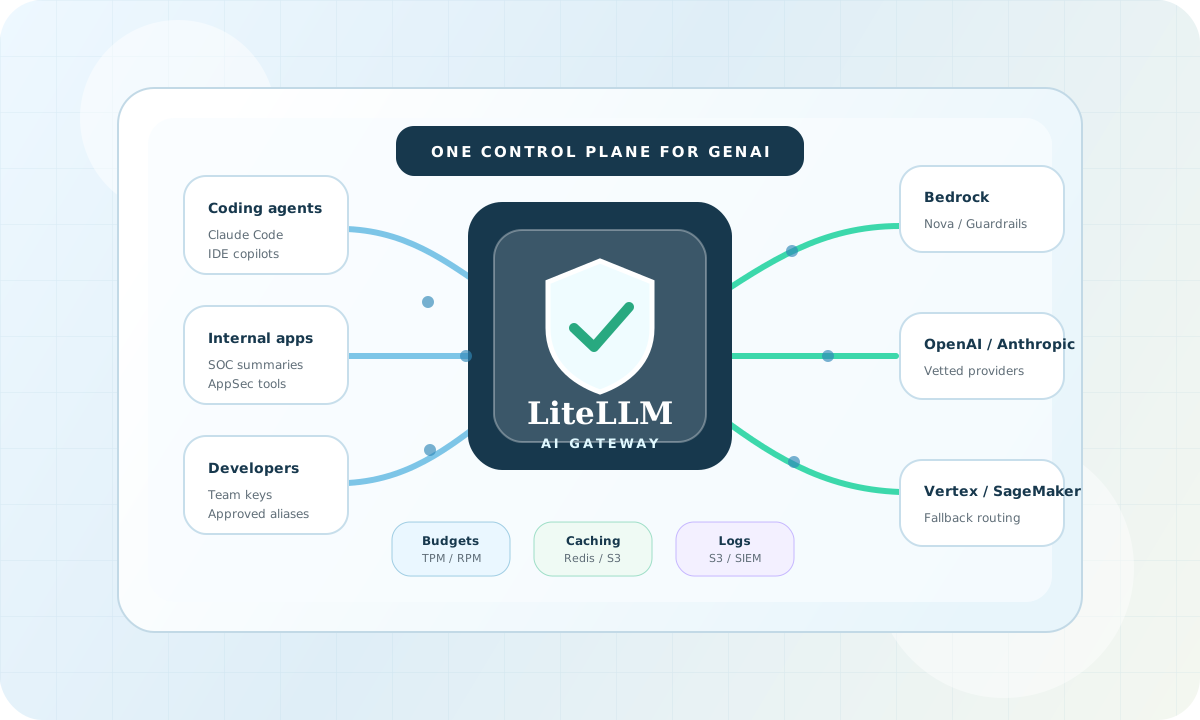
The fastest way for GenAI adoption to become ungovernable is to let every team connect directly to every model provider. One group adds OpenAI. Another adds Anthropic. A third adds Bedrock. A fourth uses an agentic coding tool with a personal key. Soon the security team is not managing AI risk; it is chasing API keys, shadow prompts, unmanaged logs, inconsistent data handling, and surprise token bills. LiteLLM offers a more practical pattern: put a centralized AI gateway between internal applications, agentic coding tools, and external or internal model providers.
AWS's Multi-Provider Generative AI Gateway guidance makes this pattern concrete. The reference architecture places a LiteLLM gateway behind Route 53 or CloudFront, protects the edge with AWS WAF, routes traffic through an Application Load Balancer, and runs the gateway containers on ECS Fargate or EKS. It then connects the gateway to Amazon Bedrock, Amazon Nova, SageMaker AI, and external providers such as OpenAI, Anthropic, and Vertex AI. The important idea is not only multi-provider convenience. It is that model access becomes infrastructure, not a pile of SDK calls scattered across repositories.
For security teams, centralization changes the control surface. Instead of asking every engineering team which model they use, where keys are stored, what data is sent, and how usage is logged, the organization can issue LiteLLM virtual keys by team, application, environment, or workflow. Those keys can be restricted to approved model aliases, attached to users or teams, tracked for spend, blocked when compromised, and configured with budget and rate-limit policy. That is much closer to how mature companies already manage cloud accounts, CI/CD deploy keys, and production service credentials.
This is especially useful for agentic code models. Coding agents are not just chatbots; they can inspect repositories, propose patches, run tests, call tools, summarize alerts, generate infrastructure code, and influence developer behavior. If every agent points directly at a different model provider, the security team loses visibility into which repositories, prompts, secrets, code snippets, and tool results are leaving the environment. A LiteLLM-style gateway gives the organization a single policy enforcement point for coding-agent traffic, including model allowlists, team metadata, request tracing, and redaction strategy.
Model vetting becomes more disciplined as well. The gateway can expose friendly internal names such as `approved-code-review`, `safe-soc-summary`, `low-cost-triage`, or `restricted-frontier-model` while routing those aliases to specific approved providers and versions behind the scenes. If a provider changes pricing, a model is deprecated, or a safer model becomes available, the platform team can update the alias centrally. Developers keep using the same endpoint, while security and platform teams control what that endpoint actually means.
The cost and token story matters just as much as the security story. LiteLLM documents spend tracking by key, user, and team, and AWS's guidance highlights usage tracking and cost management as core reasons for the gateway. That lets security and platform teams stop arguing abstractly about AI spend and start measuring it: which teams are sending the most tokens, which workloads use expensive frontier models, which prompts are too large, and which agent loops are burning budget without producing value.
Token minimization should be designed into the gateway program. Teams can set default max-token limits, route lightweight tasks to cheaper models, require explicit approval for high-cost models, and use model aliases to downgrade routine requests without breaking application code. They can also encourage prompt hygiene: remove duplicate context, summarize long histories, keep tool outputs compact, and avoid sending full repositories when a diff or file slice is enough. The gateway is not a magic tokenizer, but it creates a place where token policy can be measured and enforced.
Caching is another lever. LiteLLM supports response caching through options such as Redis, semantic caches, S3, and GCS, and AWS's guidance uses ElastiCache for prompt caching and multi-tenant settings. For repeated documentation lookups, policy explanations, test generation patterns, embeddings, and stable internal instructions, caching can reduce latency and provider calls. Security teams should still define privacy rules carefully: sensitive prompts, customer data, secrets, incident details, and privileged code context should have stricter cache policies or no caching at all.
Logging needs the same nuance. LiteLLM supports integrations with observability platforms, object storage, OpenTelemetry, cloud buckets, and security tools, and it can produce call IDs and response-cost metadata that help trace activity. But logging every prompt and response forever is not automatically wise. The better pattern is layered telemetry: capture request metadata, team, model alias, cost, route, error, cache hit, and policy decision by default; redact or disable message logging for sensitive workflows; and send security-relevant events to the SIEM or data lake with retention rules that match legal and privacy requirements.
The AWS architecture also shows what secure deployment should look like. Put the gateway behind WAF and TLS, run it in managed containers, use private networking where possible, store provider credentials in Secrets Manager, persist virtual keys and configuration in RDS, use Redis or ElastiCache for caching, and send operational logs to S3 and CloudWatch. Apply least-privilege IAM roles, separate production and development gateways, and make the admin UI reachable only through trusted identity and network paths. An AI gateway should be treated like identity and payment infrastructure, not a casual developer sidecar.
A mature rollout can be simple. First, inventory current model providers and agentic coding tools. Second, create a small approved-model catalog with risk tiers: public data, internal data, regulated data, code generation, incident response, and privileged automation. Third, route new workloads through LiteLLM virtual keys instead of raw provider keys. Fourth, add budgets, rate limits, logging metadata, redaction defaults, and cache policy. Fifth, migrate existing teams gradually by replacing direct provider SDK endpoints with the centralized gateway endpoint.
The result is not less AI. It is safer AI with less sprawl. Developers still get access to strong models. Security teams get auditability, key control, provider abstraction, cost visibility, and a place to enforce policy. Finance gets cleaner spend attribution. Platform teams get one gateway pattern instead of many hand-rolled integrations. And when a model, provider, or coding-agent behavior needs to change, the organization can adjust the gateway instead of opening a hundred pull requests.
HackWednesday's recommendation is direct: if your company is using GenAI or agentic coding tools seriously, centralize model access before the sprawl becomes permanent. LiteLLM, especially when deployed with AWS's multi-provider gateway pattern, gives security teams a pragmatic control plane for vetted models, virtual keys, logging, redaction, caching, budgets, and provider routing. The goal is not to slow AI adoption. The goal is to make AI adoption governable enough that it can keep growing.
Source notes
Every Wednesday post should link back to primary reporting or documentation so readers can verify claims quickly.